
PLEASE NOTE: All itineraries are for guidance only. Programs may vary depending on ice, weather, and wildlife conditions. Landings are subject to site availabilities, permissions, and environmental concerns per IAATO regulations. Official sailing plans and landing slots are scheduled with IAATO prior to the start of the season, but the expedition leader determines the final plan. Flexibility is paramount for expedition cruises. The average cruising speed of our vessel is 10.5 knots.
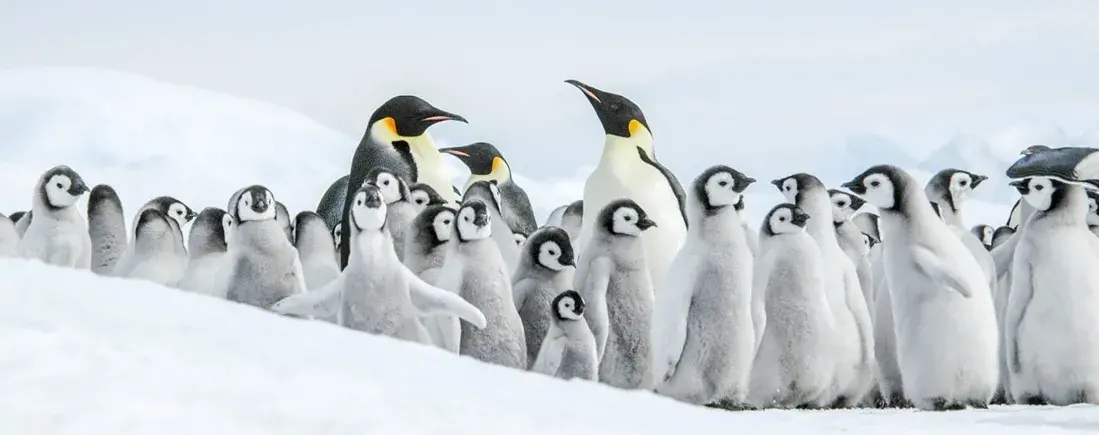
A true expedition, our Weddell Sea cruise sets out to explore the range of the Emperor Penguins near Snow Hill Island. We will visit the area via helicopter and see a variety of other birds and penguins including Adélies and Gentoos.
The Itinerary
Your voyage begins where the world drops off. Ushuaia, Argentina, reputed to be the southernmost city on the planet, is located on the far southern tip of South America. Starting in the afternoon, you embark from this small resort town on Tierra del Fuego, nicknamed "The End of the World," and sail the mountain-fringed Beagle Channel for the remainder of the evening.
Over the next two days on the Drake Passage, you enjoy some of the same experiences encountered by the great polar explorers who first charted these regions: cool salt breezes, rolling seas, maybe even a fin whale spouting up sea spray. After passing the Antarctic Convergence — Antarctica's natural boundary, formed when north-flowing cold waters collide with warmer sub-Antarctic seas — you are in the circum-Antarctic upwelling zone. Wandering albatrosses, grey-headed albatrosses, black-browed albatrosses, light-mantled sooty albatrosses, cape pigeons, southern fulmars, Wilson's storm petrels, blue petrels, and Antarctic petrels are a few of the birds you might see.
You may sail into the Weddell Sea via the Antarctic Sound. Here huge tabular icebergs herald your arrival to the eastern side of the Antarctic Peninsula. During this part of the cruise, the search is on for emperor penguins. Using both the vessel and helicopters, there's a good chance you'll find them. You might also enjoy scenic flights, and if conditions allow, helicopter landings in locations otherwise out of reach this time of year.
Helicopter Flights — A True Trip Changer
Helicopter flights may include the west slopes of the Antarctic Sound — only rarely seen from the air, with layered sandstones, lava flows, glaciers, icebergs and pack-ice extending as far as the eye can see, along with individual emperor and Adélie penguins, kelp gulls, skuas and various breeds of petrel.
Duse Bay — a soaring helicopter flight may deposit you on a rocky hillock close to an old refuge hut overlooking this bay, with much of the walk over frost-shattered rock covered with lichen of all shapes and colors.
Seymour Island — where the Swedish Antarctic Expedition of 1901–4 wintered under harrowing polar conditions. Sedimentary rock, fossils, and expansive views define this location.
Zodiac Trips, Conditions Permitting
Devil Island — home to a large colony of Adélie penguins, offering a magnificent vantage point for hikers willing to foot it to the top of the hill.
Brown Bluff — perhaps the most scenic location in the entire northern tip of the Antarctic Continent: sheer canyon walls, fallen boulders, and volcanic creations capped with ice, home to a large Adélie penguin rookery alongside gentoo penguins and nesting snow petrels.
Gourdin Island — home to chinstrap, gentoo, and Adélie penguins, another landing option for your continuing Antarctic adventure.
Esperanza Base — this Argentine research station, one of only two civilian settlements in Antarctica, could serve as an alternative landing site.
In the morning, you sail to Deception Island for the last landing of the voyage, either at Pendulum Cove or Whalers Bay. Conditions on the Drake Passage determine the exact time of departure.
Your return voyage is far from lonely. While crossing the Drake, you're again greeted by the vast array of seabirds remembered from the passage south. But they seem a little more familiar to you now, and you to them.
There and back again.
Alternate Program: Days 5–6 (If the Route to Snow Hill Island Is Ice-Free — Under 50% Probability)
Helicopters provide an advantage in reaching the emperor penguin colony, but our ability to use them depends entirely on ice, sea, and weather conditions. If conditions are favorable, we will visit the colony — and if exceptionally favorable, we will attempt to visit more than once. Helicopter operations take a full day, and flight duration depends on local conditions.
Each helicopter can accommodate 4–5 passengers per flight. The landing site is carefully chosen so that the penguins are not disturbed. Upon arrival, we will walk to the colony, which may take up to 45 minutes and can be challenging in places. This is one of the world's most remote regions, so there are no guarantees — conditions may change rapidly and impact helicopter operations. Safety is our greatest concern, so no compromises can be made.
We aim for all groups to spend an equal amount of time at the colony, though the time there (and to get there from the landing site) will often vary due to local conditions and flight times.
Experience the Bird's-Eye View of Antarctica
Our helicopter capability gives you the rare chance to see the famed emperor penguin rookery south of Snow Hill Island, numbering around 4,000 breeding pairs. Heavy ice may prevent entrance to this area from the Weddell Sea, and ice at the rookery itself might break up and start to melt earlier than expected. With this in mind, the aim is to stop the vessel between the Antarctic Sound and James Clark Ross Island, close to the ice edge, and find emperor penguins on their way to open water. The thrilling helicopter flights make this search possible, enabling you to land in locations otherwise inaccessible this early in the season.
If ice conditions are favorable and the route to Snow Hill Island is free of multi-year pack ice, you have the chance for ship-to-shore helicopter transfers to Snow Hill Island (roughly 45 minutes' walking distance from the emperor penguin rookery). If successful, this is a once-in-a-lifetime experience. But nature writes the final itinerary out here: attempts to reach Snow Hill Island during the voyages of 2012–19 did not always succeed. However, in 2013, 2017 through 2019 and 2022, conditions were favorable to land by helicopter on Snow Hill Island and visit the emperor penguin rookery.