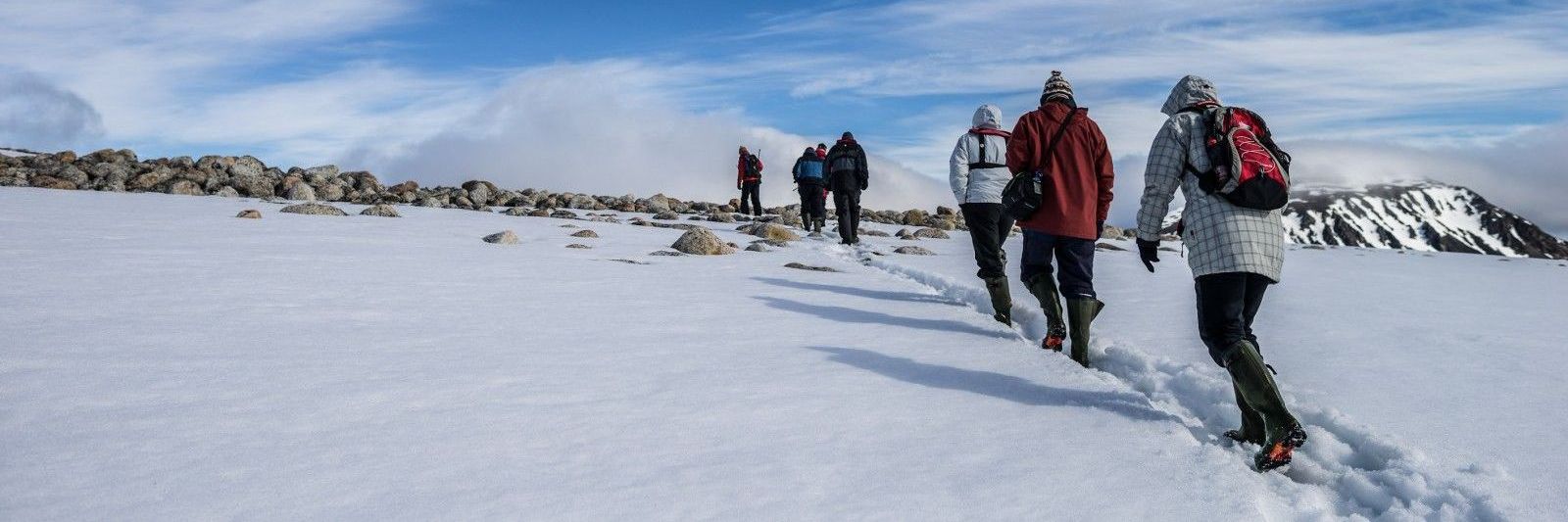
Imagine standing high up on a slope, overlooking an ice-filled bay. Wind ruffles the surface of the bay, kayaks glide across it and you smile as you realize that Antarctica is everything you imagined it would be. Images of snow, ice, mountains and glaciers dominate our ideas of what we will experience on a voyage to Antarctica. We will introduce you to a new view of Antarctica! On every voyage, we will plan to offer hikes for the more active traveller. This will not happen on every excursion, however with our extensive experience in the peninsula region, we have some good hikes in mind for each voyage.
Who can do it?
Anyone can participate in our hiking program, this is largely due to our commitment to offer varied hikes dependant on what people want to do. Where possible we tailor the options to offer our contemplative walk (for those wanting to stay close to shore and not hike up slope), our mid range hike and our longer hikes. The longer hikes can range from two to three hours in duration, and may involve challengin terrian without the assistance of trails. If you are unsure about your ability to participate in any activity, please discuss your concerns with our hiking guide and opt for the most suitable option. There are always options on most excursions for shorter walks, often up to excellent viewpoints, or along a beach.
Do I need to be experienced? How physically fit do I need to be?
For the basic walks you just need to be in reasonably good shape and health. The hikes last usually somewhere between 2 and 6 hours. Keep in mind that there are no paths and that you will be travelling over fairly rugged terrain and will be taking on some hills. There are usually 1 to 3 different types of walks offered (except in the case of our sailing vessel the Noorderlicht) per landing ranging from a casual stroll to a challenging hike. In the Antarctic the longest hike takes about 2 hours while in the Arctic the longest hike can last a full day (we send you off with a packed lunch).
We do reserve the right to suggest that a passenger try another activity if it seems like they will not be able to enjoy a particular hike. This is done partly for the enjoyment of the other passengers and partly for safety concerns – if there is a health incident there is no help beyond basic first aid in the vicinity. Our experienced guides will be able to reco
What is provided?
Although our hikes take place only in areas where we have deemed it safe to travel, our guide does carry safety equipment. We also have trekking poles onboard for your use and snowshoes to help improve your traction on slick services and deep snow.
However, you do want to bring clothing that is suitable for the changeable weather of the Polar Regions. Layers are your friend – you’re going to get hot as you work your way around the tundra and you’ll want to be able to shed a layer or two without losing a big percentage of your elemental protection.
With that in mind we suggest:
- Hiking/walking poles.
- Rubber boots that are high enough to get you from the Zodiac to the shore and have a good gripping sole for the shore landings and walks. (Boots are provided on some ships).
- A waterproof bag (especially for cameras) – you’re likely to get splashed during the Zodiac ride from the ship to the shore.
- Straps for tying snowshoes onto your back or backpack.
- Ankle-high sturdy hiking boots for the actual treks and for wearing snowshoes.
- Sunblock.
- You might want gaiters (knee-high waterproof protection) to keep your lower legs dry while hiking.
Sunglasses.
- A backpack (25 litres is a good size).
- Thin under-socks (to stop blistering) and thick over-socks. (Bring some dry spares as well.)
- A 1-litre water-bottle.
- Thermal under-gloves (fleece finger gloves) and warm outer-gloves or mittens (you might want a spare set of these as well).
- A turtle-neck or neck gaiter.
- A urine-collection bottle (regulations forbid leaving human waste behind in the Antarctic). Try looking for something like a wide-opening Nalgene bottle (they sell specialised versions for ladies at outdoor shops).
- Thermal underwear.
- A fleece jacket or vest.
- A down jacket or spare fleece jacket.
- A breathable (e.g. Gore-Tex) jacket and trousers.
- Trekking trousers.
- A warm fleece hat.
- Optionally, you might also want to bring along binoculars, and a Thermos bottle.
Don’t bring regular cotton clothing like t-shirts or jeans if you can avoid it because if it gets wet (either from outside moisture or sweat) it will stay wet – not a good thing in a cold environment.